Application Procedure
All applications will be submitted electronically via the F6S platform. Applicants will need to:
- Read the Annex 1 – Guide for Applicants;
- Familiarize themselves with the call documentation:
- – Annex 1.1B Catalogue_Type B-Transition Agenda_v1.0
- – Annex 2B Proposal Template_Type B-TAD_v1.1
- – Annex 2.1B Application form at the F6S platform_Type B Transition Agenda Development (TAD)_v1.1
- – Annex 3B Sub-Grant Agreement_Type B_ TAD_v1.0
- – Annex 4.1B Consortium Declaration of Honour (template)_Type B_TAD_v1.1
- – Annex 4.2B Beneficiary Declaration of Honour (template)_Type B_TDA_v1.1
- – Annex 5B SME Declaration (template)_Type B_TAD_v1.0
- – Annex 6B Bank account information (template)Type B_TAD_v1.0
- Create an F6S account;
- Fill in the application form for TAD projects at F6S platform
- Prepare their proposal in the respective templates
- Submit their proposal before the deadline via the F6S platform
Submissions sent by any other means will not be accepted.
From Eligibility to Impact: How to Participate in the Mission Ocean Mediterranean Calls
The open calls will be targeted at Communities of actors within EU Member States or Associated Countries.
Applicants must be entities established in the EU or Associated Countries and active in the Mediterranean basin. Activities must take place in the Mediterranean basin.
Eligible applicants include: regional and local authorities, NGOs, associations, research and education institutions and SMEs active in the eligible geographical areas.
Each organisation may submit only one proposal per call.
All applications must be submitted in English.
Applicants must comply with all EU sanctions and restrictive measures.
Number of required Beneficiaries per project: 1 or 2 Ben Individual legal entities or consortia of maximum 2 legal entities, representing a Mission community.
Target TAD beneficiaries are typically entities focused on policy, governance, and stakeholder coordination: Regional and local authorities, NGOs focused on policy advocacy, Research Performing Organisations conducting legal harmonisation studies, and Associations developing multi-stakeholder dialogue frameworks among others.
All projects must be implemented in the Mediterranean Basin, with at least one partner from a Mediterranean country.
Detailed eligibility criteria are listed in the Annex 1 – Guide for Applicants.
Applicants are required to select a single primary Pillar for their project's focus. The entire proposal—including the project's challenge, objectives, methodology, and expected outcomes—must be explicitly designed to achieve the goals of this chosen Pillar:
- Pillar #1: Protecting and Restoring Marine and Freshwater Ecosystems and Biodiversity
- Pillar #2: Prevent and eliminate pollution of our ocean, seas, and waters
- Pillar #3: Ensuring a Sustainable, Carbon-Neutral, and Circular Blue Economy
Further a list of inspired topics per Pillar is available here and applicants are expected to select a topic or propose one of their choice and commit to the targets aligned with their choice.
Transition Agenda (TA) will support the creation of local and regional roadmaps for sustainable transformation in the Mediterranean.
Projects should:
- Develop or adapt legislation to support Mission Ocean-related solutions;
- Identify regulatory gaps and promote policy innovation to enable emerging technologies;
- Engage stakeholders (local authorities, citizens, industries) in co-designing and testing governance models.
The TAD project are expected to:
- analyse policy gaps (including both restricting legislation and entirely missing frameworks) that impact marine environment,
- create a detailed legislative roadmap to address these issues, and
- develop a governance strategy for effective, harmonized implementation.
Selected projects will receive technical assistance, capacity-building, and access to TASC-RestoreMed’s expert network and facilities.
Support services may include:
- Technical and scientific advisory services;
- Partnership facilitation and clustering with other Mission projects;
- Business plan development and funding guidance;
- Impact assessment support and alignment with SDGs;
- Access to relevant data, knowledge, and infrastructures;
- Coaching and mentoring sessions.
Transition Agenda projects will receive guidance on stakeholder engagement, governance design, and policy alignment within the Mission Ocean Mediterranean Lighthouse framework.
Grants will be awarded as lump sums covering personnel and direct costs (e.g., goods and services, equipment, travel, subcontracting, and dissemination activities).
Payments will be made in instalments linked to project milestones and deliverables.
Transition Agenda Development (TA):
- Total funding available: €1 million
- Funding support: up to €100,000 per project
- Maximum amount per Third Party: €100,000
- Minimum 10 projects funded
- Project duration: 12 months
- 40% pre-financing, 40% interim, 20% final payment upon final report approval.
Applications will be evaluated by independent experts following the principles of transparency, equal treatment, and non-discrimination.
Each proposal will be assessed by at least two (2) external evaluators for the Transition Agenda Call.
Evaluation criteria will include:
- Excellence:
- Relevance and Clarity of the Objectives
- Soundness of the Analytical Basis
- Innovative and Systemic Approach
- Integration of Cross-Cutting Dimensions
- Impact:
- Contribution to Mission Ocean and Waters Objectives
- Impact in the Mediterranean Sea
- Wider and long-term impacts
- Quality of the dissemination, exploitation and communication plan
- Implementation:
- Quality of the Work plan, its work packages, deliverables and milestones
- Justification and coherence of the requested FSTP funding
- Quality and completion of the consortium
For Transition Agendas, emphasis will be placed on governance innovation, stakeholder participation, and policy applicability.
Ranking will be based on consensus scoring. Then interviews will be conducted with the highest-scoring proposals selected from every Pillar of application. The final list of selected projects will be approved by the consortium and communicated to applicants.
Projects will sign a Sub-grant Agreement with F6S - the TASC-RestoreMed partner handling the FSTP budget.
For more details regarding the evaluation and contracting process, refer to Annex 1 Guide for applicants.
All personal data will be processed in compliance with the EU General Data Protection Regulation (GDPR).
Projects must adhere to the highest ethical standards and comply with EU and national legislation in all areas relevant to their proposed activities.
More details about the data protection and ethics aspects can be found in the Annex 1 – Guide for Applicants as well as in the respective Sub-grant agreement template.
The Open Calls will be launched and managed according to the TASC-RestoreMed project implementation plan.
Each call will remain open for approximately six (6) months.
Evaluation and contracting will follow the internal roadmap of the project.
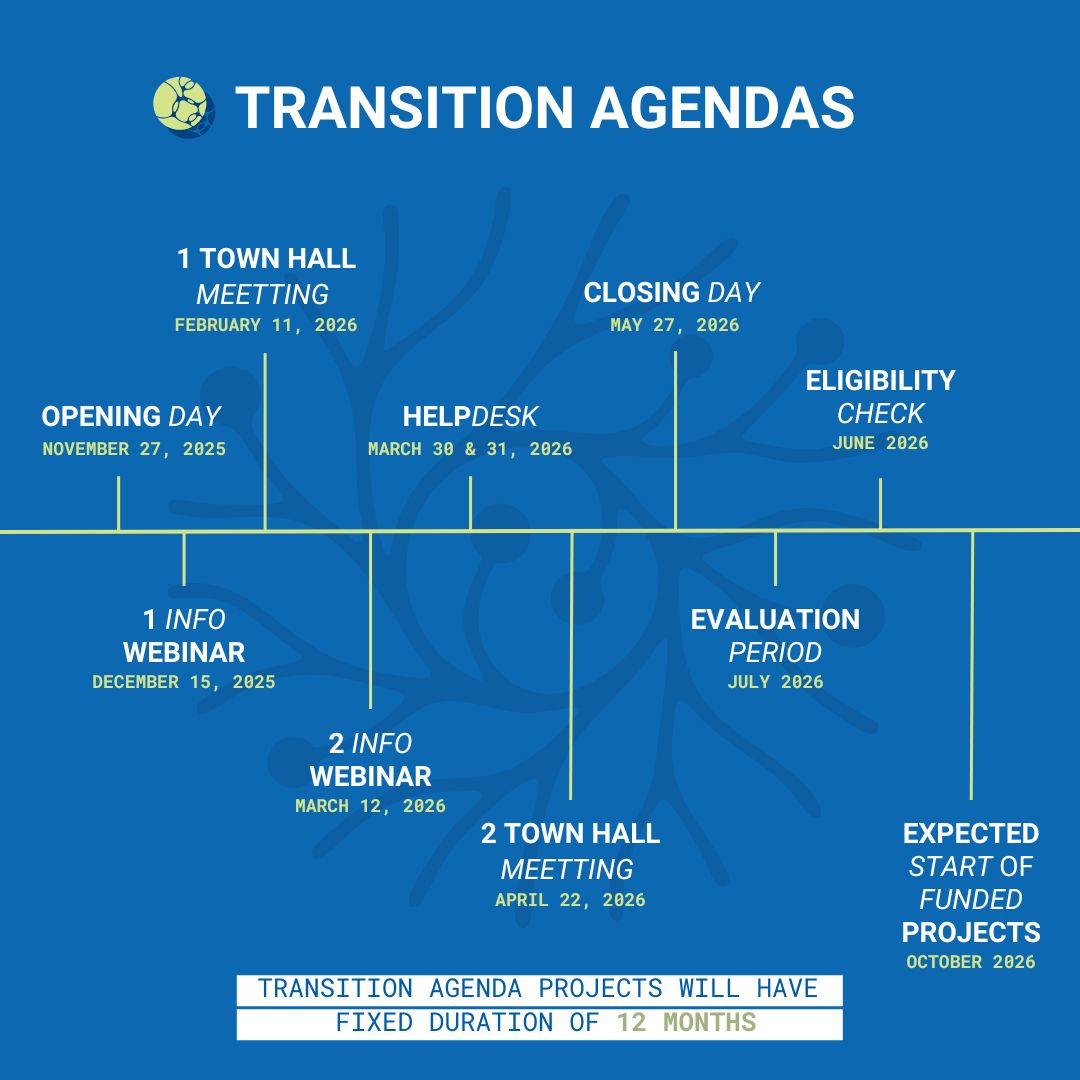
Opening date: November 27, 2025
1 Info Webinar: December 15, 2025
2 Info Webinar: March 12, 2026
Helpdesk: March 30 & 31, 2026
Closing date: 27/05/2026 (17h00 CET)
Eligibility & Technical check: by mid June 2026
Application evaluation: until the end of July 2026
Online interviews and announcement of the results: by the end of September 2026
Expected start of funded projects: from October 2026
Transition Agenda projects will have a duration of 12 months.
How many types of Open Calls are available, and can I apply for both?
There are two distinct types of Open Calls under the TASC-RestoreMed project: Type A (Community-Led Actions – CLA) and Type B (Transition Agenda Development – TAD). You must choose only one track. An organization (whether as a lead or a partner) can submit more than one application but only in one of the two open call types (CLA or TAD).
For more details, see Section 3.1.4 of the Annex 1 Guide for Applicants.
What is the fundamental difference between Type A (CLA) and Type B (TAD)?
The two tracks target different stages of the Mediterranean restoration mission:
- Type A (CLA) focuses on implementation and scaling. It is for projects ready to deploy existing research and innovative solutions (at least TRL 5) in real-world settings.
- Type B (TAD) focuses on strategy and governance. It is for projects dedicated to creating regional roadmaps, policy agendas, and legal frameworks to enable future restoration work.
For more details, see Section 2 (Open Call) of the Annex 1 Guide for Applicants.
Which track is right for my organization?
- Choose Type A (CLA) if you are a consortium of at least two partners (a solution provider and an adopter) ready to perform on-the-ground restoration with a budget of up to €1.4M over 24 months.
- Choose Type B (TAD) if you are an individual entity or small team (max 2) focused on policy, governance, and stakeholder roadmaps with a budget of up to €100k over 12 months.
For more details, see Section 2.4 (Table 1) of the Annex 1 Guide for Applicants.
Who is eligible to participate in the TASC-RestoreMed Open Call?
Eligible applicants must be legal entities with a valid VAT registration (except for entities without a legal obligation to hold one), established in an EU Member State or a Horizon Europe Associated Country. The call is open to a diverse range of actors, including regional and local authorities, NGOs, research and educational institutions, associations and SMEs, etc.
For specific eligibility rules per track, consult Section 3.1.1 of the Annex 1 Guide for Applicants.
What are the geographical requirements for these calls?
All project activities regardless of the the type of Open Call must be implemented within the Mediterranean Sea basin, including marine, transitional, and freshwater bodies. Furthermore, every project must include at least one partner legally established in a Mediterranean Sea basin country.
Detailed location eligibility is found in Section 3.1.2. of the Annex 1 Guide for Applicants.
Which specific countries are considered part of the Mediterranean Sea basin for this call?
Eligible basin countries include: Albania, Algeria, Bosnia and Herzegovina, Croatia (EU), Cyprus (EU), Egypt, France (EU), Greece (EU), Israel, Italy (EU), Jordan, Kosovo, Lebanon, Libya, Malta (EU), Monaco, Montenegro, Morocco, North Macedonia, Palestine, San Marino, Serbia, Slovenia (EU), Spain (EU), Syria, Tunisia and Türkiye i.e. provided that they are either EU Member State or associated to Horizon Europe at the date of the publication of the call. At least one partner in every project must be legally established in one of these countries.
For further details, consult Section 3.1.2 of the Annex 1 Guide for Applicants.
Can an organization submit more than one proposal?
Yes, an organisation may be involved in multiple proposals (as a lead or a partner) within the same Open Call Type. Organisations must restrict their applications to only one type of call (either Type A: CLA OR Type B: TAD).
Dual applications across both types remain ineligible and will result in exclusion.
Are large corporations (Big Corporates) eligible to receive funding?
No. Large corporations (entities that do not qualify as an SME) are ineligible to receive funding under this Open Call. To ensure compliance, a company must meet the SME definition as defined by the European Commission Recommendation 2003/361/EC.
For further details, consult Section 3.1.6 (Table 3) of the Annex 1 Guide for Applicants. 12
What criteria are used to evaluate my proposal?
Proposals are scored on a scale of 0 to 5 based on three main criteria: Excellence (40%), Impact (40%), and Implementation (20%). The minimum threshold per criterion is 3/5, and the overall total must be at least 9/15.
For further details, consult Section 4.2.1 of the Annex 1 Guide for Applicants.
How are "tie-breaks" (ex aequo) handled if two projects have the same score?
Priority is given in the following order: (1) highest score in the Impact criterion, (2) highest score in the Excellence criterion, (3) gender balance within the consortium, and (4) lowest requested budget.
For further details, consult Section 4.2.3 of the Annex 1 Guide for Applicants.
Is there an interview stage?
Yes. Shortlisted applicants from both the CLA and TAD tracks will be invited to a 30-minute online interview with consortium experts to clarify proposal details18.
For further details, consult Section 4.3 of the Annex 1 Guide for Applicants.
How is the funding paid out during the project?
Payments are distributed in three installments based on the successful completion of “Sprints”:
- Type A (CLA): 40% (pre-financing), 45% (interim at M18), and 15% (final at M24)
- Type B (TAD): 40% (pre-financing), 40% (interim at M8), and 20% (final at M12)
- For further details, consult Section 6.1 (Tables 9 & 10) of the Annex 1 Guide for Applicants.
What costs are considered "Eligible"?
Eligible costs under the lump-sum model include personnel, depreciation of equipment, mandatory travel, consumables, and subcontracting (max 20% of the total budget).
- For further details, consult Section 3.2.2 of the Annex 1 Guide for Applicants.
Are there mandatory travel requirements to budget for?
Yes. Applicants must budget for attendance at the TASC-RestoreMed Final Event and at least one other physical event to promote project results.
- For further details, consult Section 3.2.2 of the Annex 1 Guide for Applicants.
Which documents must be completed and submitted during the initial application phase?
Applicants must submit all required files through the F6S platform by the deadline of 27 May 2026 17:00 CET. The mandatory documents vary slightly by track:
- For both Type A (CLA) and Type B (TAD):
- Proposal Template: (Annex 2A for CLA or Annex 2B for TAD).
- F6S Online Application Form: Completed directly on the platform (refer to Annex 2.1A or 2.1B for a document version for reference).
- Mandatory Reading: Applicants must confirm they have read the Annex 1: Guide for Applicants and the relevant Catalogue (Annex 1.1A for CLA or 1.1B for TAD).
- For further details, consult Section 3.3.1 (Table 5) of the Annex 1 Guide for Applicants.
Which documents are only required once a project is selected for funding?
If your proposal is successful, you will enter the contracting phase, where additional administrative and financial verification occurs. You do not need to submit these during the initial application.
- Sub-grant Agreement (SGA): The final contract (Annex 3A for CLA or 3B for TAD).
- Declaration of Honour: Signed by the lead and each partner (Annex 4A for CLA, or 4.1B/4.2B for TAD).
- SME Declaration: Required if an applicant is an SME (Annex 5A or 5B).
- Bank Account Information: To facilitate payments (Annex 6A or 6B).
- Legal & Tax Proof: Formal evidence of the entity’s legal existence and VAT registration.
For further details, consult Section 5 (What happens after selection?) of the Annex 1 Guide for Applicants.
What happens if I miss a document or submit it in the wrong format?
Ιncomplete applications or those not using the official templates will be disqualified during the initial Eligibility & Technical check. All documents must be submitted in English and in PDF format unless otherwise specified.
For further details, consult Section 3.3.3 of the Annex 1 Guide for Applicants.
What is the focus of Type B: Transition Agendas?
Type B projects are dedicated to identifying governance gaps and creating strategic regional/local roadmaps (Transition Agendas) that pave the way for future solution deployment. The goal is to create the political and legal environment necessary for long-term sustainability.
For more on the objective, ambition, and strategic focus, refer to Section 2.2 of the Annex 1 Guide for Applicants.
Can I apply for a TAD project alone?
Yes. Type B is open to individual legal entities or consortia of a maximum of two legal entities. This allows for a targeted approach to policy advocacy or legal harmonization.
For detailed applicant eligibility and relevant entity types, consult Section 3.1.1 of the Annex 1 Guide for Applicants.
What is the maximum budget and duration for a TAD project?
he maximum grant is €100,000 per project, with the same cap applying to a single beneficiary. The implementation duration is fixed at 12 months.
Budget summaries and key project characteristics are detailed in Section 2.4 (Table 1) of the Annex 1 Guide for Applicants.
Are there specific "Sprints" for TAD projects?
Yes, the 12-month TAD programme is structured into three mandatory Sprints: Sprint 1 (Policy & Challenge Assessment), Sprint 2 (Validation & Refinement), and Sprint 3 (Legacy).
To see the full programme timeline and requirements for each phase, review Section 6.1 of the Annex 1 Guide for Applicants.
Who owns the Intellectual Property (IPR) created during the project?
Results achieved by the funded projects belong solely to the third parties who developed them. Applicants retain ownership of their respective IPRs.
For further details, consult Section 7.1 of the Annex 1 Guide for Applicants.
Where can I ask specific questions during the application phase?
Questions can be sent to opencall@tascrestoremed.eu. Additionally, online Q&A/discussion boards are available on the F6S platform for both CLA and TAD tracks.
For further details, consult Section 8 of the Annex 1 Guide for Applicants.
Join the Info Webinar #2: TAD Mediterranean Aquatic Roadmaps
Are you ready to move from high-level strategy to regional impact? We are offering up to €100k in equity-free funding combined with a specialized support framework to help you turn your governance strategy into a tangible regional reality.
The Info Webinar will be held online on March 12, 1:00pm – 2:00pm.